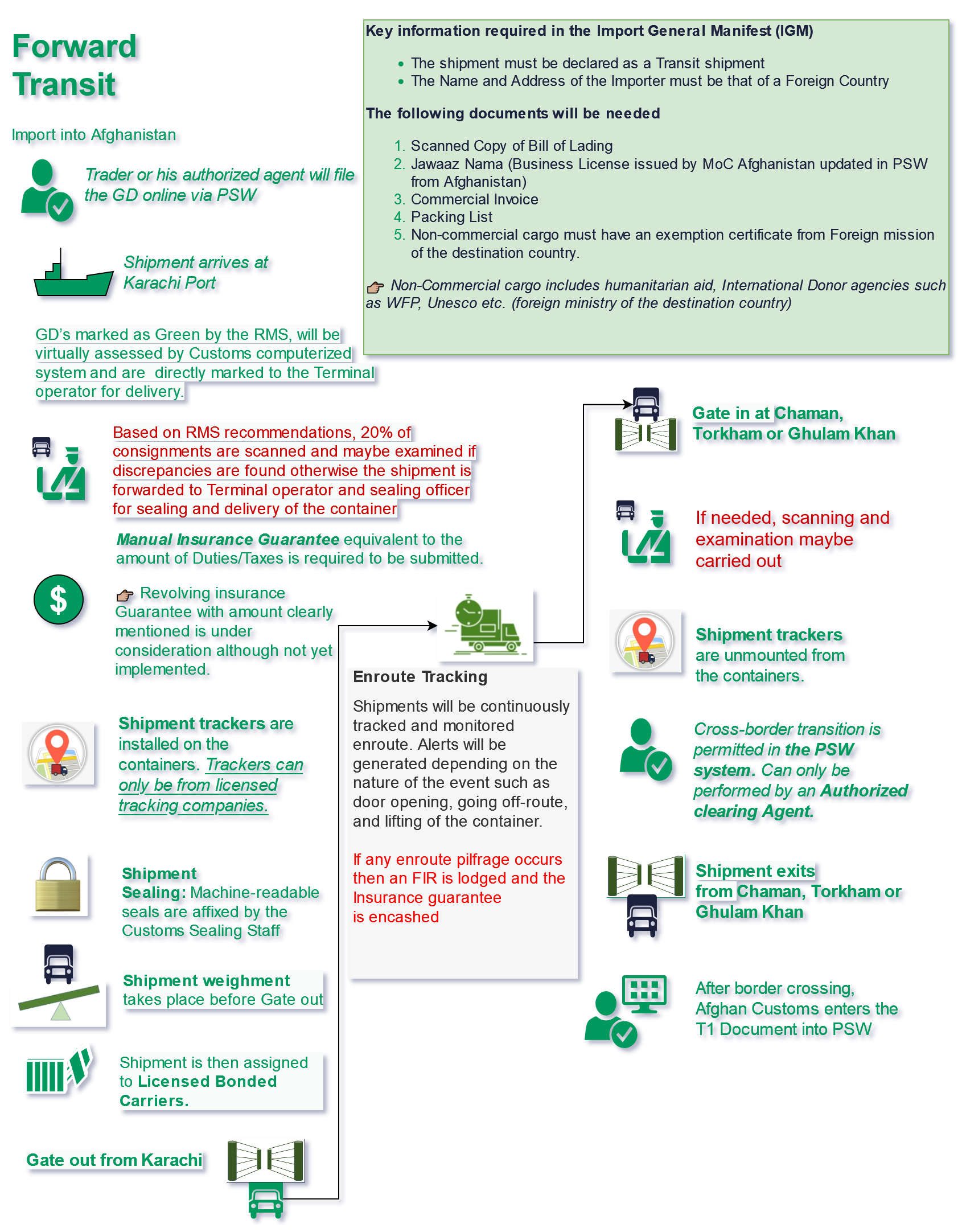

Forward Transit
Currently the transit regime has only been established for goods travelling from another country into Afghanistan/ Uzbekistan or from Afghanistan/ Uzbekistan to other countries, through Pakistan. If and when more such transit agreements are established with other countries, the rules will be largely based on the existing framework. Therefore, the guidance below has been generalized.
⇒SRO 121 of 2014 read in conjunction with SRO 1013 of 2021 governs the requirements and rules around Goods Declaration filing related to Forward Transit shipments
 Note: As per SRO
151 of 2004, Cigarettes and
Auto-Parts are banned for Transit
(complete Checklist of banned/restricted items maybe extracted from APTA Annex-A to Protocol-4
The Key requirements are as follows
1. In the Import General Manifest (IGM), the destination country to which goods will transit through Pakistan MUST be declared.
2. Importer name and country name should be that of a foreign country
3. Trader or his authorized agent will file the GD online in WeBOC
4. Required Documents
➜ Scanned copy of BL
➜Jawaaz Nama (Business License issued by MoC / Uzbekistan) updated in WeBOC from Afghanistan/ Uzbekistan)
➜ Commercial Invoice
➜ Packing List
➜ Revolving insurance Guarantee with amount clearly mentioned (under consideration – not yet implemented)
➜ For non-commercial cargo must have an exemption certificate (Mafi Nama)
Non-Commercial
cargo includes humanitarian aid, International Donor
agencies such as WFP, Unesco etc. (foreign ministry of the destination country)
⇒ GD’s marked as Green by the RMS, will be virtually assessed by Customs computerized system and will directly be marked to terminal operator for delivery.
⇒ 20% of the Consignments are scanned based on recommendation of RMS
If
discrepancy is found during scanning, the
Consignment maybe examined
If no
discrepancy is found, the GD maybe forwarded to
Terminal Operator and sealing officer for delivery
and sealing of the container respectively.
⇒ Manual/Revolving Insurance Guarantee equivalent to the duties/taxes of the goods is required to be submitted. (List of approved insurance companies provided in Rules)
⇒ Weighment is performed upon gate-out from Karachi Port
⇒ A tracker is installed on the container until the shipment exits the borders of Pakistan.
The tracker
should be from a licensed tracking company in
Pakistan.
⇒ Machine readable seals are installed by the customs sealing staff.
⇒ The container is then assigned to the bonded carrier
⇒ En route live tracking and monitoring takes place and an alert is generated depending on the nature of the event such as door opening, going off-route and lifting of container.
If any
enroute pilfrage occurs then an FIR is
lodged and the Insurance guarantee is
encashed
⇒ Once the shipment reaches the exit border post (Chaman, Torkham, Ghulam Khan)
Border
Agent physically obtains all the necessary clearances
If needed,
scanning and examinations maybe carried out
Tracker is unmounted
Cross
border
transition is permitted in the WeBOC system
After Cross
border Afghan Custom uploads T1 document in
WeBOC