



Government of Pakistan
Pakistan Environmental Protection Agency
(Ministry of Environment)
NATIONAL BIOSAFETY GUIDELINES
Related Reference: Pakistan Biosafety Rules, 2005
S.R.O 336(I)/2005
Note: The Pakistan Biosafety Rules, 2005 will prevail in case of any contradiction or omission in these Guidelines
Table of Contents
2. GUIDELINES FOR LABORATORY WORK
4. REGULATIONS AND CONTAINMENT DURING FIELD TESTS
5. COMPOSITION AND FUNCTIONS OF VARIOUS BIOSAFETY COMMITTEES
6. SPECIAL REQUIREMENTS FOR SOME LABORATORY GENETIC MANIPULATION WORK
7. MOVEMENT OF REGULATED MATERIALS
8. LEGAL FRAMEWORK GOVERNING IMPLEMENTATION OF BIOSAFETY RULES/ NATIONAL BIOSAFETY GUIDELINES
9. FRAMEWORK OF THE VARIOUS PROPOSALS/APPLICATIONS
10. FORMAT OF PROJECT PROPOSAL FOR PERMISSION TO UNDERTAKE LABORATORY GENETIC MANIPULATION WORK
11. FORMAT OF PROJECT PROPOSAL FOR PERMISSION TO UNDERTAKE FIELD TRIALS
13. SPECIFIC PROVISION TO GRANT EXEMPT STATUS
EXECUTIVE SUMMARY
1. Recognizing the revolutionary economic potential of the new biotechnology in agriculture, health, industry, environment and energy sectors; and appreciating the concerns that mixing of genes from unrelated organisms might create natural imbalance that is not yet adequately understood; and considering the fears that manipulated genes or products thereof if allowed to move around freely in nature, may pose potential hazards; and realizing the apprehensions that certain transgenic organisms may be harmful or become harmful to economic plants, animals and human being; and discharging the obligations of the Convention of Biological Diversity (CBD) and Cartagena Protocols to which Pakistan is a signatory; the Minister of Environment, constituted a National Biosafety Expert Committee to deliberate on these issues to regulate the safe release of Genetically Modified Organisms (GMOs) and products thereof.
2. Consequent upon extensive deliberations/consultation with all the stakeholders, the national committee concluded that there is a national need to develop biosafety guidelines to control laboratory research, field studies and commercial release of GMOs and products thereof, as have been done by all the developed countries and many developing countries.
3. Accordingly, a set of National Biosafety Guidelines have been developed through a national forum participated by all the stakeholders including the academic institutions, R&D organization, industry, non-government organizations and human right societies.
4. These guidelines have been prepared keeping in view the guidelines prepared by UNIDO, FAO, WHO, UNEP, and all the developed and developing countries with modification to suit our unique and specific socio-economic and geographic environment.
5. The objective of these guidelines is to prevent unintentional negligence leading to misuse and irresponsibility by laboratory workers/researchers as well as the end- users.
6. To define the bounds guidelines/regulatory jurisdiction of these guidelines, biotechnology has been defined as processes using living organisms or parts thereof to make or modify products; and to improve plants, animals, or microorganisms for specific uses. “Recombinant DNA” has been defined as molecules developed outside living cells by joining natural or synthetic DNA segments to DNA that can replicate in a living cell and those DNA molecules that result from the replication of such DNA.
7. For the purposes of these guidelines, regulated material includes all genetically modified materials (DNA & RNA preparations, viroids, viruses, cells and organisms, modified or constructed through genetic engineering), derivatives thereof and wastes or by-products of genetic engineering practices (containing viable organisms or otherwise).
8. The scope of these guidelines embraces all works related to gene manipulation employing recombinant DNA technology for all purposes including the development of transgenic plants, animals and microorganisms; production of vaccines; industrial manufacturing of Genetically Modified Organisms and products thereof, and their release into the environment for field trials as well as for commercial uses.
9. The Guidelines consist of two parts; the first part relates to regulated work in laboratory research and field trials;and the second part deals with procedures for approvals which must be obtained to deregulate the regulated materials to allow their free movement and commercial uses.
10. All regulated laboratory research works are classified into (a) Minimal risk, (b) Low risk, (c) Considerable level of risk and laboratory containment conditions are accordingly prescribed. For regulated fieldwork, comprehensive containment conditions have been prescribed separately for genetically modified microorganisms plants and animals.
11. The mechanism of monitoring and implementation of the proposed guidelines is built on three tiers as specified in the Biosafety Rules, 2005, namely a National Biosafety Committee (NBC); a Technical Advisory Committee (TAC); and Institutional Biosafety Committees (IBCs) at the institutional levels. The NBC headed by the Secretary, Ministry of Environment will be responsible to oversee all laboratory work, field trials and allow commercial releases of GMOs and their products.
12. Enforcement of various clauses of the National Biosafety Guidelines will be administered by the three monitoring implementation bodies, as per legal authority under Clause 7(g) of the Pakistan Environment Protection Act 1997.
13. The IBC may recommend to NBC for awarding exempt status for Laboratory work/field work with genetically modified organisms, if there is sufficient information/grounds available to consider the work as having no risk and NBC may consider for formal approval.
14. Permission for deregulation granted by the NBC can be withdrawn if sufficient technical data/evidence becomes available after the approval, which warrants its deregulation.
15. To standardize processing, separate format for application/proposal for obtaining permission to undertake laboratory genetic manipulation work, field trial and commercialization have been designed.
16. A separate application format has also been designed for the movement of regulated materials and/or exempt status.
17. Instructions for the preparation of applications as well as for its assessment have also been prescribed to streamline and standardize the procedures for assessment and evaluation.
18. These biosafety guidelines have been developed on the basis of technical information presently available and may change in the future as more know-how becomes available. Therefore, revision of these guidelines will be a continuous process.
19. These biosafety guidelines will be supplemented with annexures explaining/elaborating concepts, procedures and protocols required in monitoring/implementation of the guidelines.
C H A P T E R 1
"Biotechnology" is a collective term, encompassing a number of technologies, some old, others new. Plant and animal breeding are examples of traditional biotechnological methods. Making of foods, such as, bread, cheese, and yogurt; and medicines such as vaccines and hormones, are known products of old biotechnological methodologies. Modern biotechnology involves the more precise ability to effect genetic changes to produce improved or even new traits and includes such new techniques as recombinant DNA and gene cloning collectively referred to as "genetic engineering".
The precise definitions of "biotechnology" and of other terms such as "recombinant DNA" are of extreme importance when used as part of biosafety guidelines/regulations, particularly because they define the bounds of guidelines/regulatory jurisdiction. "Biotechnology" has been defined as processes using living organisms or parts thereof to make or modify products; and to improve plants, animals, or microorganisms for specific uses. "Recombinant DNA molecules" have been defined as molecules developed outside living cells by joining natural or synthetic DNA segments to DNA that can replicate in a living cell or DNA molecules that result from the replication of such DNA.
Modern Biotechnology has led to the development of new products/processes which manifest distinct advantages for the prevention and treatment of diseases, in the increased production of medically important compounds and improved vacancies. Recent breakthroughs include microbial production of human insulin, growth hormone, interferon, urokinase beta- endorphin, thymosin, alpha-3 somatostatin, tissue plasminogen activator. The list of biologically active compounds which can be made by Genetically Modified Organisms (GMOs) is increasing every day and it is believed that in the next 15-20 years, we will be able to produce all biological proteins by Genetically Modified Organisms. Through the use of powerful gene cloning and molecular immunological techniques, vaccines against malaria and hepatitis B have been prepared. Vaccines for trypanosomes, schistomyces, and leprosy are in the final stages of preparation. Monoclonal antibodies are being used for diagnostic and therapeutic purposes and this has made possible early diagnosis and cure of many dreadful diseases. Prenatal diagnosis has paved the way to bring down the incidence, of such genetic diseases as beta-thalassemia. Since heredity plays a part in virtually all diseases, including diabetes, cancer, cardiovascular disorders, multiple sclerosis, rheumatoid arthritis, schizophrenia and a number of other disorders known to run in families, efforts are being made to sequence the causative genes to use this information in prenatal diagnosis in order to reduce the incidence, if not, completely eliminate these diseases.
In the industrial sector, modern biotechnology has paved the way for bacterial desulphurization of coal and petroleum; microbial production of fructose, polypropylene glycol, olefins and parafins; enrichment of precious metals, enhanced oil recovery, clearing of oil spills, sewage treatment and pollution control. The world production of organic chemicals is close to
100 million metric tons, about 90% of which are oxy-chemicals. It has been estimated that 60-
80% of oxy-chemicals and 20% of all other chemicals used by man, can be produced microbiologically.
Traditional plant breeding techniques are limited by sexual incompatibility barriers. In addition, valuable traits such as tolerance to specific herbicides and nitrogen fixation do not exist in plants. Biotechnological methods allow to overcome the genetic incompatibility barriers. Genes can be isolated from bacteria, viruses, fungi, plants or animals and made to express in easy and quick growing organisms. Genetically Modified Organisms (transgenic plants, animals and microorganisms) have been produced and used commercially. Globally over 70 different commercially important species of plants have been modified to incorporate mainly seven transgenic traits (Table-1). The important crops include maize, soybean, cotton, tomato, potato, alphalpha, petunia, rape/mustard, rice, wheat, beet, barley, chickpea (gram), cabbage and tobacco.
Table-1
|
Genetic transfer of traits in transgenic plants by recombinant DNA technology |
|
• Herbicide tolerance • Insect resistance • Viral disease tolerance • Fungal disease tolerance • Product quality improvements • Male sterility traits • Others (production of metabolites/ chemicals, improvement of nutritional traits, incorporation of marker genes, stress resistance properties etc.)
|
1.1 REASONS FOR CONCERNS
As part of gene transfer technologies, target genes from unrelated organisms can be isolated and used after appropriate attachment of marker genes, the promoter and the terminator sequences for expression into new hosts to improve the productivity of organisms. Gene transfers are considered exotic because the genes from unrelated organisms are made to express in organisms whichdo not normally host them. Such mixing of genes from unrelated organisms might create natural imbalance by the transfer of genetic traits into organisms, the nature has so fa not ordained. The onsequence of flow of genes into unrelated organisms is not yet adequately known. There are apprehensions that certain transgenic organisms may be harmful or become harmful to economic plants, animals and human beings; and that manipulated genes or products thereof, if allowed to move around freely in nature, may pose potential hazards that include the following:
A. Changes in ecological roles:
Engineered changes in growth rate, reproductive output longevity, tolerance of physical and chemical factors (e.g., temperature, salinity, water legging, pesticides, etc.) can change the relative performance of GMOs with respect to naturally-occurring organisms. As a consequence, the performance of GMOs will be enhanced sufficiently to negatively impact other organisms. An often-cited example is the potential for increased weediness among herbicide-tolerant crops. Increased weediness could have negative impact on surrounding agricultural fields or on wild vegetation in nearby fields. Both impacts could have economic consequences, either directly, through loss of valuable crop-land, or indirectly, through loss of services in the ecosystem.
B. Changes in genetic relationships:
Many GMOs will retain the ability to interbreed with their non-engineered relatives. Interbreeding will allow the production of hybrid progeny expressing engineered traits. Such hybrids could be formed between GMOs and domesticated wild organisms. In either case, hybridization will alter the distribution of phenotypes within domesticated or wild populations, and will serve to change the role of the organism(s). In the most extreme cases, introgressive hybridization could lead to genetic contamination of economically important crops, or to extinction of native species or other species of local importance leading to loss of bio-diversity.
The potential for horizontal gene transfer among prokaryotes (e.g., microbes), from microbes to plants and vice-versa is of special concern. Horizontal gene transfer among eukaryotes, may occur by the action of transposons, but its occurrence is thought to be less frequent than in prokaryotes. Be as it may, such horizontal transfer of genetic material could allow engineered genes to move into populations other than the target host, with undesirable consequences.
C. Changes in allergenicity, toxicity, or nutritional composition of foods:
The presence of novel proteins in "familiar" foods could prove hazardous to individuals who suffer specific allergies to those proteins. Further, the production of toxins, even at very low levels, could have adverse effects on human health over the long term. In addition, foods grown for human consumption cannot be entirely isolated from other organisms and exchanges of genes in the environment. Thus, human food sources could become contaminated by novel genes introduced for purposes other than human consumption.
D. Indirect effects:
The indirect and effects of releasing GMOs into the environment include changes in population mating structure, alteration of competitive hierarchies, and modification of the physical and chemical environments. Such alteration might lead to changes in population structure and size through changes in species number. Indirect effects are difficult to predict, detect, and monitor, but may have substantial impact in the functioning of the ecosystem.
E. Ethical and social Issues:
The use of GMO’s vis-a-vis religious belief, distribution of seeds to low-income farmers and product labeling, may give birth to ethical and social issues which can have serious consequences in the unique socioeconomic set-up in Pakistan. It is anticipated that the recently concluded International Treaties on Patent and Intellectual Property Rights such as WTO coupled with present level of investment by different Nations in R&D in biotechnology, will aggravate the situation by further widening the existing gap in the biotechnological capabilities of the developed and developing countries.
1.2 NEED FOR BIOSAFETY GUIDELINES/REGULATIONS
The concerns narrated above in Section 1.1 clearly show that the development and use of transgenic organisms in the open environment has to be looked at with caution to ensure safety of user and the environment. This has raised the need to develop and adopt safety protocols during laboratory experimentation as well as during eventual use of Genetically Modified Organisms (GMOs) and the products thereof. As a rule, research on GMOs is carried out by competent researchers who are fully conscious of good laboratory practices and the acceptable safety of releasing the GMOs into the environment. Nevertheless, progress and accomplishment made during the past decade has, evoked concerns among researchers themselves. The main concern is that human desire to rapidly progress coupled with pressures from research financers to rapidly produce, can result in complete forgetfulness of the appropriate need to adopt good laboratory practice and/or necessary experimentation/field trials that must be done in order to be able to eventually develop and release transgenic and/or products thereof, into the open environment. It is therefore necessary to develop appropriate biosafety procedures to guide scientific researchers during their laboratory work to develop Genetically Modified Organisms and to enable the eventual use of Genetically Modified Organisms as well as products thereof in the open environment for economic gains. The main goal of developing biosafety procedures is to discern, as far as possible, the potential for harm to the environment and/or human well-being stemming from GMO's and the products thereof.
A number of developed countries have prepared biosafety guidelines for both laboratory research and field applications of GMO’s and their products. Such guidelines differ from one country to another, however, the guiding principle is to ensure safety and minimize all the risks which are likely to occur, encountered or subsequently generated. It took the United States and Europe nearly two decades to develop regulations and other oversight mechanisms pertaining to biotechnological work. There is no easily stated unifying principle and as a consequence, many of the guidelines developed by different regulatory agencies/countries at different times have not been consistent in their approaches and the differences are attributed mainly to different legislative mandates. It seems doubtful that there ever will be a single or unified international basis of "biotechnology regulation". The subject area actually involves a complex variety of technologies and products thereof. Further, individual view points, guided by religious and social believes, on each of these diverse subjects can differ dramatically. This diversity of viewpoint can create, and has resulted in, different biosafety regulations.
Many developing countries have used guidelines in developed countries as references and then modified or amended in compliance with the relevant laws, regulations and local conditions. At the international level, UNIDO, FAO, WHO, UNEP, and other such agencies have prepared guidelines which have helped developing countries to formulate their own biosafety guidelines. As far as Pakistan is concerned, there is immediate need to formulate national biosafety policy to regulate all biotechnological work in the country in order to eliminate the concerns narrated in the previous pages. Such a policy will, undoubtedly, promote R&D efforts in biotechnology in the country and also help to foster collaborative ventures between local and foreign scientists/laboratories interested in joint experimentation, laboratory testing or field trials of GMOs in Pakistan. This is the main rationale upon which the following Biosafety Guidelines are developed.
The objective of these guidelines, prepared by the National Biosafety Committee (NBC), is not to enforce stringent regulations such that they will impair activities in the research and development of recombinant DNA technology in the country. At the same time, the objective is also not to be too lenient to allow unintentional negligence leading to misuse and irresponsibility by certain researchers or laboratories. The scope of these guidelines embraces all works related to gene manipulation employing recombinant DNA technology for all purposes including the development of transgenic plants, animals and microorganisms, production of vaccines, industrial manufacturing of Genetically Modified Organisms and products thereof, and their releases into the environment for field trials and for commercial purposes. The National Biosafety Committee realizes that these guidelines are far from complete and future amendments and revisions are unavoidable. As more information becomes available, it will be incorporated to make the present guidelines more feasible and supportive of the overall development of biotechnology in the country.
1.3. BASIS OF BIOSAFETY GUIDELINES
The biosafety guidelines described on the succeeding pages, have been developed to prevent possible adverse effects resulting from recombinant DNA laboratory work and the deliberate release of resultant Genetically Modified Organisms and products thereof, on human health and environment. Considering the purposes of these guidelines, regulated material includes all genetically modified materials (DNA and RNA preparations, viroids, viruses, cells and organisms, modified or constructed through genetic engineering), derivatives thereof and the wastes or by-products of genetic engineering practices (containing viable organism or otherwise). The Guidelines consist of two parts; the first part relates to regulated work in laboratories and fields. The second part deals with procedures for approvals which must be obtained to deregulate the regulated materials to allow their free movement and commercial uses.
1.3.1. All regulated works are classified according to level of anticipated risk and safety, into three categories:
A) Work bearing minimal risk,
B) Work bearing low risk,
C) Work bearing considerable level of risk.
It is important to divide all works into various categories according to anticipated levels of risk so that risk management and control measures can be taken accordingly (details are in appendices).
1.3.2. The proposed guidelines suggest three tiers for monitoring and implementation. Firstly, the Principal Investigator and researchers are responsible to themselves and to the community. The monitoring and inspection will be done by the Institutional Biosafety Committee (IBC). In the whole set-up, the IBC is an important organ and occupies a pivotal position. It forms the foundation of the entire set-up. The Committee will receive applications, propose measures for laboratory set-up as well as planned release and effectively monitor them. All information/data that needs to be submitted to the subsequent two tiers, will have to go through the IBC which therefore, must consist of people adequately qualified to understand the associated risks and evaluate them accordingly.
Secondly, a Technical Advisory Committee (TAC) which will have the major responsibility to technically review all applications for licensing and ensure that the GMOs or any product under consideration has gone through proper risk assessment under these guidelines.
Thirdly, a National Biosafety Committee (NBC), set-up under the Ministry of Environment, will act as the executive body for the overall monitoring, risk management and commercial release of all regulated materials. Chapter-5 gives details on the composition and functions of the various committees.
1.4. SCOPE OF GUIDELINES
1.4.1. Laboratory Work
These guidelines are pertinent to all research whether conducted in laboratories of teaching and research, research and development institutes or private companies-involved in the uses and applications of GMO’s and products thereof.
The question whether a particular endeavor rests within the scope of these guidelines, should be addressed by preparing a proposal according to the format in Chapter-10, and submitting it to the Institutional Biosafety Committee (IBC). In the event, an IBC has not been properly established, the same proposal should be submitted to the TAC through the controlling ministry for consideration. Researchers, with even the slightest doubt in these matters, are encouraged to seek guidance from their parent administrative Ministry or the Ministry of Environment, Islamabad.
1.4.2. Field Work
These biosafety guidelines cover all work involved in the field trial of genetically manipulated plants, animals and microorganisms. As a rule, laboratory work must precede all field trials. As a standard practice, genetically manipulated organisms from laboratory work must be field tested before commercial release into the environment. The proposed field trials should:
i) repeat the experiments made during laboratory work, and verify the results from tests performed at the laboratory level.
ii) gather precise and accurate information/data on the stability, expression and hereditary transmission of transgenes under field conditions.
iii) assess the viability (e.g. survival, propagation, competitive ability) of genetically manipulated organisms under field conditions.
iv) assess the adaptive or evolutionary potential of genetically manipulated organisms under changing environmental conditions.
& v) asses the overall environmental impact.
1.4.3. Commercial Release of Regulated Materials
These guidelines also cover procedures needed to deregulate regulated materials for commercial purposes. As a standard practice, sufficient information should be available from the field trials to make a decision whether the GMO or its product can be released for public use. In this regard, it is extremely import to include all informations/considerations as well as data which formed the basis of deregulation/commercial release in another country. The procedures for preparing applications and assessment by different regulatory bodies is presented in Chapter-12.
C H A P T E R 2
GUIDELINES FOR LABORATORY WORK
The guidelines classify all laboratory work into three main categories.
2.1. RISK CATEGORY 1 WORK:
2.1.1. Biosafety:
Risk Category 1 work appears to convey minimal risk, nevertheless, such work must be undertaken in compliance with standard practices for conventional microbiological laboratories. Experiments involving pathogenic organisms should conform to suitable containment and precautionary measures including personnel training and instructions. Laboratory staff should be familiar with all pathogenic organisms under study and aware of the appropriate safety procedures required (Appendix-1).
2.1.2. Liaison with the Institutional Biosafety Committee (IBC)
All work to be considered minimal risk status must initially be referred to the IBC for notification and approval. In the absence of an IBC for the institution supporting the work, the responsible workers should refer directly to the concerned ministry for endorsement of their proposals. A standard form, to be submitted to the IBC for consideration of project exemption, is outlined in Chapter-13. Individual IBCs are at liberty to design additional forms as well, following the terms of the standard proposal for request of exempt status. The Institutional Biosafety Committee will make the final decision as to whether a proposal warrants Risk Category 1 or other categories in the light of available information. As such, no work which falls under the scope of these guidelines should be initiated unless approval is awarded by the IBC, regardless of the risks.
For the work that has already been considered as risk category 1, further modifications of consequence, to any component of the experimental system, which may place this status in jeopardy, must be referred back to the IBC for its approval, a second time. A revised proposal together with the original proposal should be submitted to the institutional biosafety committee which will review the amendments and judge whether such amendments place the work in higher-risk category. The concerned ministry will be informed if the IBC has placed the amended work in risk category 2 or 3.
2.1.3. Experiments characterized as Risk Category 1
Experiments characterized as risk Category 1 include:
A. Tests involving organisms that naturally exchange genetic material, provided that the donor and the recipient are of the same species or that the donor species is capable of exchanging genetic material with the recipient species under natural circumstances. A list of such combinations is found in Appendix-2. and in which the donor DNA exhibits all of the following properties:
• is not derived from microorganisms which cause diseases in humans, plants or animals.
• represents or comprises no more than 2/3 of any complete viral genome and is employed in such a manner as to disallow the possible regeneration of live viruses (as opposed to such work wherein the hosts carry the missing segments of viral genomes or whereby regeneration is made possible under the context of ensuring propagation sequences).
• does not code for proteins which regulate the growth of mammalian cells (e.g. product of oncogenes), for cytotoxic proteins, or for toxins, to vertebrates, with an LD50 of less than 100ug/kg (Appendix-3).
B. Fusion of protoplasts among non-pathogenic microorganisms or between plant cells (embryo rescue).
C. Fusion of cells derived from 'higher' animals but which does not result in a viable organism such as in the creation of hybridomas without the use of a viral stimulator (e.g. EBV for production of monoclonal antibodies.
2.2. RISK CATEGORY 2 WORK
2.2.1. Biosafety
Risk Category 2 work may pose "low" levels of risks towards laboratory personnel, the community or the environment and necessitates, at the very least, containment level C1. Situations involving whole plants and animals should normally be conducted under PH1 plant glass houses or C1A animal houses. Certain types of work (IBC will decide on the basis of expert opinion on the subject) however, may call for further safety precautions or high levels of physical containment (e.g. special containment conditions in some animal houses designed for transgenic species) because the DNA concerned, or segments and fragments thereof, may conceal hazards or cause disease. Such work will be negotiated on a case-by-case basis with the IBC. Regulations and criteria for the procedures, facility design and containment features at the various biosafety levels are outlined in Appendices 4 through 11.
2.2.2. Liaison with the Institutional Biosafety Committee
The project supervisor or head researcher has the primary responsibility for identifying the nature of potential hazards within the laboratory and for determining additional precautions -- supplementing the relevant standards laid down in Appendices 4 through 11 -- appropriate to the level of risks and concerns in this category of work. The need for additional procedures and conditions are to be in line with, and address the specific risks. The project proposal from the project supervisor must be referred to the IBC for consideration. The IBC shall evaluate the proposed ambient working conditions and containment resources and determine the sufficiency of these provisions. Considering the risk assessment results, the IBC may also impose special requirements on the work at hand. The work will start only after obtaining IBC approval. The IBC must then forward the proposal and its assessment thereof, to the NBC via TAC record- keeping.
2.2.3. Experiments Characterized as Risk Category 2 Include the Following:
A. Work with previously approved host/vector systems (Appendix-2) but in which the genetic material inserted exhibits one or more of the following properties.
• codes for proteins regulating cellular metabolism, growth or division.
• represents a pathogenic determinant.
• represents an uncharacterized DNA or RNA sequence derived from microorganisms which cause diseases in humans, plants or animals.
B. Work with non-approved host/vector systems.
C. Genetic engineering of modified whole plants. Supplementary information form required for submission is outlined in Chapter-10.
D. Altering the genome of oocytes, zygotes or early embryos, through any means, to the extent that a novel organism results.
• Genetic manipulation work on live animals (microorganisms notwithstanding) to the extent that a novel organism results.
2.3. RISK CATEGORY 3 WORK
2.3.1. Biosafety:
Risk Category 3 distinction is placed on work which may pose a substantial level of risk to laboratory personnel, the community or the environment. Gene-therapy work and work for which the character and degree of the risks are as yet uncertain fall under this category. With such an array under the umbrella of Risk Category 3, appropriate containment levels are far more rigid and may vary considerably depending on the inherent nature of the experiment and on risk assessment results, containment level C1 may be adequate for some types of work whereas other situations may demand higher levels of containment and experienced personnel.
2.3.2. Liaison with the Institutional Biosafety Committee
The IBC serves, in part, as a conduit for the flow of information between the researchers and the, NBC forwarding proposals, assessments and recommendations. Work is prohibited before consent is granted by the IBC/NBC and only after both biosafety committees have inspected and reviewed the project proposals, and advised the relevant authorities on any measures that work should be allowed.
2.3.3. Work Characterized as Risk Category 3 Include the Following:
A. Application of genes determining pathogenicity in microorganisms other than the approved host microorganisms listed in Appendix-2.
B. Transfer of whole viral genomes, viroids or genetic fragments known to initiate infection in humans, plants or animals. In general, work using gene sequences less than 2/3 of any complete viral genome and work involving genetic material lacking components vital to the proper functioning of problem operons, to replication or to the packaging of new viral particle are excluded from this subcategory, provided that experimental conditions disallow the regeneration of live, infectious viruses.
C. Recombinations between complete viral genomes, viroids and/or complementary fragments thereof determined to be of infectious or pathogenic nature.
D. Alteration of host range for infection, virulence or infectivity.
E. Work using viral vectors capable of infecting human cells.
F. Work using microbial hosts or vectors which are human, plant or animal
pathogens with the exception of those listed as approved hosts and vectors under Appendix-2.
G. Application of genetically manipulated DNA sequences coding for proteins known to regulate cell growth or to be toxic to human cells.
H. Work involving toxin producers including:
• DNA coding for toxins with an LD50 of less than 100ug/kg (Appendix-3) or otherwise, exhibiting high levels of gene expression regardless of how low the toxicity of the protein encoded.
• Uncharacterized DNA from toxin-producing microorganisms which may contain unfamiliar toxin-determining sequences.
I. Use of defective vector/helper virus combinations which heightens the tendency of regenerating non-defective recombinant viruses.
J. Genetic engineering of animals to secrete or to produce viruses, through the injection of viral genetic material or of whole viral genomes into embryos.
K. Propagation through cloning.
• Gene-therapy work through genetic modification of any nature.
2.4. UNCHARACTERIZED WORK
2.4.1. Works which do not fall under Categories 1,2 and 3 because it deals with completely uncharacterized materials but which nonetheless fall under the coverage of these Guidelines as defined, shall be treated as Risk Category 3 work. Considering this special provision, researchers attempting such uncharacterized work must adhere to the requirements imposed by Risk Category 3 distinction.
2.4.2. The standing of any research work is liable and subject to change in either direction (from lower to higher risk categories or vice versa) as appropriate new information or further procedural revisions are implemented, subsequent to relevant notification. Project supervisors must submit revised project proposals to the IBC for consideration and recommendation before adopting radical operating procedures or substantially changing any parameter of the work (especially approaches to physical and biological containment) which may introduce novel risks, delimit new biosafety levels or warrant change of classification.
2.4.3. Researchers who wish to restrict access to information of commercial significance (e.g. trade secrets or confidential business reports) provided to the various committees, should mark the relevant sections "Commercial-in-Confidence".
C H A P T E R 3
3.1. GENETICALLY MODIFIED MICROORGANISMS
Field work with genetically modified microorganisms must first take into consideration the nature or character of the biological system, as follows:
3.1.1. For microorganisms, considered to have a history of safe use in the field, work may proceed in accordance with the basic standards appropriate to the particular microorganism. Those microorganisms,
A. which are from a strain that has been involved in previous documented field work;
B. which perform the same functions as strains that have been involved in previous documented field work;
C. which remain confined to sites and surroundings that resemble previous field conditions, are considered to have a history of safe use.
3.1.2. For experimental microorganisms which do not meet the above conditions, the work may proceed under appropriate containment levels as presented in Regulations and Containment Section. The proposed measures of containment must observe any one or more of the following conditions:
A. There is appropriate biological containment, where:
• Microorganisms are rendered non-reproducible before being field tested; or
• Modifications are done to limit the survival of microorganisms outside, and to confine microorganisms within target areas.
B. Genetic inserts and constructs may be exchanged or transferred to other microorganisms only in a restricted area.
C. There are physical arrangements to contain the dispersal of microorganisms within the target areas or site of trial.
3.1.3. In the case of those microorganisms which do not have a history of safe use in field, the work may proceed with a preliminary risk assessment to determine the full range of possible environmental effects. Those microorganisms recognized as "problematic" that have been engineered for the,
A. Sustenance and nourishment of plant species, which may therefore provide nutrients in excess to disrupt the chemistry of associated plants;
B. destruction of toxic residues which may prompt secondary ill-effects;
C. biological control of plant pests which may overwhelm target species and thus produce toxic or pathogenic metabolites, spreading ill-health in wild populations at the trial site.
3.2. GENETICALLY MODIFIED PLANTS
Field work with genetically modified plants must first take into consideration the nature or character of the biological systems, as follows:
3.2.1. For experimental plants considered to have a history of safe use in the field, the work may proceed in accordance with the basic standards appropriate to the particular plant. Those plants are considered to have safe history that have been modified by,
A. conventional breeding practices (e.g. selective breeding, mutagenesis, protoplast fusion or embryo rescue) and/or having inherent characteristics typical of modified plants from conventional breeding practices,
B. the introduction of genetic inserts that are known to be harmless and non-
hazardous to the environment.
3.2.2. For experimental plants which do not meet the conditions of 3.2.1, work may proceed under appropriate containment level and criteria, as presented in Chapter-4. The said measures of containment must observe any one or more of the following conditions:
A. There is no cross-hybridization.
B. There are arrangements to contain the dispersal of plants and plant materials.
C. Introduced gene expression is stable, and does not fluctuate with changing environmental conditions.
3.2.3. In the case of those plants which do not have a history of safe use in the field, work may proceed with a preliminary risk assessment to determine:
A. Effects on the ecology of the trial site.
• Increased resistance to diseases and pests.
• Propensity for weediness.
• Effects on other target and non-target organisms.
B. Effects on the ecology in the open environment
• Potential for cross-hybridization.
• Promotion of and stimulus for the growth and development of weeds.
• Invasion of wild populations beyond the trial site.
C. Effects on other elements in the surroundings.
3.3. GENETICALLY MODIFIED ANIMALS
Breeding of genetically modified animals should be conducted in accordance with the following:
A. Genetically modified animals should be bread in breeding containers clearly distinguishable from other containers used for breeding non-engineered animals. Further, genetically engineered animals be individually distinguished and housed, however, if individual distinction becomes difficult, small laboratory animals may be managed according to breeding groups.
B. Wastes relating to genetically modified animals (including dead bodies should be disposed off after sterilization and incineration as necessary.
C. In transporting genetically modified animals outside the work area, containers possessing sufficient strength and structure to prevent escape, should be used.
D. The word “Handle with Care” in “distinguishable ink” should be clearly displayed on all containers that house genetically modified animals.
E. Maintenance and management facilities and equipment etc used for these studies should be performance – tested at the time of installation and periodically and thereafter to maintain original performance level.
F. A sign stating genetically modified animals should be posted at each work area.
G. The work area should be kept clean.
H. Working clothes should be worn in the work area only.
I. When transferring genetically modified animals to other facilities and other personnel the person responsible must notify receiving personnel of all the relevant information.
C H A P T E R 4
REGULATIONS AND CONTAINMENT DURING FIELD TESTS
4.1. GENETICALLY MODIFIED MICROORGANISMS
4.1.1. Experimental Microorganisms with a History of Prior Work
Field testing of microorganisms with a history of prior field work, still requires submission of a project proposal to the IBC which shall evaluate the sufficiency of biosafety provisions. Measures for the control and containment of field work should observe relevant, regulations and must address the particular microorganism(s) under study. The work will begin, only after receiving IBC endorsement. The IBC must forward all proposals and assessments, to the NBC through the TAC for records and information.
4.1.2. Experimental Microorganisms with No History of Prior Field Work
Field testing of experimental microorganisms with no history of prior field work should proceed under the advice, counsel and direction of the IBC and NBC. In such cases, approvals will be based on the biosafety concerns that may be gathered from the written proposals submitted. The project supervisor is prohibited from initiating work before consent is granted by the NBC.
Considering the risks involved with untested experimental microorganisms, measures for the control and containment of field trial must set aside provisions for the following:
A. The medium for testing experimental microorganisms (e. g. soil, water, or air) is regulated and contained, at levels approved by the NBC.
B. The boundaries of testing areas need to be clearly demarcated, and posted with "No Entry" signs. Use of testing areas is strictly regulated.
C. The dispersal of experimental microorganisms is monitored closely with a reliable and effective technique, approved by the NBC.
D. Arrangements are made to destroy/inactivate experimental microorganisms, at the conclusion of work.
E. Other measures which the NBC or IBC deem suitable.
4.2. GENETICALLY MODIFIED PLANTS
4.2.1. Experimental Plants with a history of Prior Work
Field testing of experimental plants with a history of prior field work at home or aboard, still requires submission of a proposal to the IBC which shall evaluate the sufficiency of biosafety provisions. Measures for the control and containment of field work should observe relevant regulations. In these situations, work may begin only after receiving IBC endorsement. The IBC must forward all proposals and the committees assessments, to the National Biosafety Committee through concerned ministry for records and information.
4.2.2. Experimental Plants with No History of Prior Field Work
Field testing of experimental plants with no history of prior field work should proceed under the advice, counsel and direction of IBC, and the concerned ministry. In such cases, approvals will be based on the biosafety concerns that may be gathered from the written proposals submitted. The project supervisor is prohibited from initiating work before consent is granted by the NBC.
Considering the risks involved with untested experimental plants, measures for the control and containment of field trial must set aside provisions for the following:
A. Contained tests may be conducted in plant glass houses, on site. The scale and period of contained cultivation is appropriate to both the nature of the investigation, and the nature of the particular plant.
B. The site chosen is suitable to the particular plant under study. Test plots are fenced in and isolated from feral populations. "No Entry" signs are put up at regular intervals around the perimeter.
C. Arrangements are made to collect, burn and destroy experimental plants and plant materials at the conclusion of work.
D. The cultivation of plants is surveyed and directed by the IBC, at regular intervals, as appropriate to the growth or developmental patterns of the particular plant.
E. Other interests, which the NBC or IBC deems suitable.
4.3. GENETICALLY MODIFIED ANIMALS
A. Field trials of genetically modified animals with history of prior field work at home or abroad, may begin after receiving IBC endorsement. The IBC must forward all proposals and the committee’s assessment to the National Biosafety Committee (NBC) through the concerned ministry for records and information.
B. Field testing of experimental animals with no history of prior field work should proceed under the advice, council and direction of IBC and the concerned ministry. The project supervisor is prohibited from initiating work before consent is granted by the NBC. Considering the risks that may be associated with the uses of genetically modified experimental animals, all measures for the control and containment of field trials must be observed.
C. Please also see pages 31-32 & 34.
C H A P T E R 5
COMPOSITION AND FUNCTIONS OF VARIOUS BIOSAFETY COMMITTEES
The implementation of bio-safety practices in genetic engineering and biotechnological work will be supervised by the National Biosafety Committee (NBC), the Institutional Biosafety Committee (IBC) and the Project Supervisor.
The various authorities retain different powers and responsibilities yet are bound by the common objectives of enforcing and of preserving the integrity and the intent of national guidelines.
All three committees will have the powers to ensure adherence to the specifications of national guidelines for the safety of personnel, the community and the environment from the risks that may be associated with the study. In case of non-compliance of prescribed biosafety measures, whether deliberate or unintentional, the Committee which accorded approval, will have the powers to stop work after giving a show cause notice and proper investigation through the relevant IBC. The NBC will have the powers to prescribe additional safety measures/conditions to intervene in any other manner through the relevant IBC.
In the discharge of its functions and responsibilities, the various committees may co-opt additional members, form sub-committees and adopt other such measures which may facilitate its work.
5.1. THE NATIONAL BIOSAFETY COMMITTEE (NBC)
Constituted by the Ministry of Environment
5.1.1. Composition of NBC
(a) Secretary, Ministry of Environment Chairperson
(b) Member (Biosciences), Pakistan Atomic Energy Commission Member
(c) Chairpersons of concerned Institutional Biosafety Committees Members
(d) Representatives of Provincial Governments Members
(e) Representatives of Government of AJK Member
(f) Chairman, PARC Member
(g) Representative Ministry of Food & Agriculture Member
(h) Representative Ministry of Health Member
(i) Representative Ministry of Science and Technology Member
(j) Representative Ministry of Education Member
(k) Director-General, Department of Plant Protection Member
(l) Director-General, Pakistan EPA Member
The Director-General, Pakistan EPA, shall act as Secretary of the National Bio-safety
Committee.
5.1.2. Functions of National Biosafety Committee.—
(1) The National Biosafety Committee shall perform the following functions; namely:-
(a) to establish standards and procedures for risk assessment and labeling of living modified organisms, substances or cells and products thereof.
(b) to consider application(s) for import, export or commercial release of living modified organisms, and on the recommendations of Technical Advisory Committee allow release or reject applications after reviewing the risk assessment carried out in accordance with the biosafety guidelines, the procedures established under clause (a) and any other reliable information.
(c) to ban or restrict import, export, sale, purchase or trading of any living modified organism causing or likely to cause risk to public health, safety or environment.
(d) to develop linkages with foreign biosafety committees and relevant agencies to ensure that genetic manipulation practices in Pakistan address international biosafety concerns and observe universal codes of conduct.
(e) to cooperate with other relevant federal or provincial authorities overseeing the import and release of living organisms and formulate guidelines for the identification, inspection and regulation of transgenic species exotic organisms and others.
(f) to restrain on the advice of Technical Advisory Committee any person, authority or institute involved with genetic manipulation experiments of potential hazards.
(g) to facilitate exchange of technical expertise to various research institutions and regulatory agencies in setting up appropriate experimental conditions.
(h) to facilitate all levels of supervision of genetic manipulation work by assisting other regulatory bodies including Institutional Biosafety Committees, in establishing pertinent codes disciplines and guidelines for the appraisal of biohazards and the management of bio- safeguards.
(i) to coordinate efforts of Institutional Biosafety Committees and inform and educate the public on biosafety issues and on proposed national policies.
(j) to ensure that laboratory, field work and commercial release of Genetically Modified
Organisms and their products conforms to the National Biosafety Guidelines.
(k) to prepare and provide to Institutional Biosafety Committees the various notifications and assessment forms, biosafety guidelines, related documents and assorted signs for facilities.
(l) to inform the various institutions engaged in genetic manipulation work about new developments in biosafety so as to avoid exposure of laboratory personnel, the community or the environment to undue risks.
(m) to coordinate efforts between pertinent government agencies and private organizations to maintain safety levels in biotechnological work and to prepare them for biological emergencies.
(n) to certify high-level laboratories, plant glass houses and animal houses intended for use in high-risk work. Upon request by the institution, and at the earliest convenience, the National Biosafety Committee may inspect a facility and either issue certification, or recommend additional precautions, if elements of the facility are determined to be inadequate to support the types of risk or hazard companying work requiring such physical containment.
(o) to inspect high-level laboratories and containment facilities on a regular basis. The National Biosafety Committee may inspect laboratories and facilities of containment level C2, PH2. and C2A, as specified in the bio safety guidelines, equivalent or higher at any time subsequent to certification without prior notice.
(p) to inspect systems equipment and instruments governing ambient biosafety levels in genetic manipulation laboratories.
(q) to keep information of commercial significance confidential from public domain if so requested in writing by applicant, person or institution or organization.
(r) to monitor the safety related aspects of on going research projects and achievements involving genetically engineered organisms/hazardous substances or cells and products thereof.
5.1.3. Postal Address of NBC
C/o Director General (Pak-EPA) Tel: 92-51-9217882
(Ministry of Environment) Fax: 92-51-9206343
44-E, Aly Plaza, 3rd floor, Fazal-e-Haq Road E-mail: pakepa@isb.compol.com
Blue Area, Islamabad (Pakistan)
5.2. TECHNICAL ADVISORY COMMITTEE (TAC)
5.2.1. Composition of TAC
Technical Advisory Committee:—
(1) The Federal Government shall, by notification in the official Gazette, establish a Technical Advisory Committee consisting of the following members, namely:-
|
i) ii) |
Director-General, Pakistan EPA Director, National Institute for Bio Technology and Genetic Engineering, Faisalabad. |
Chairperson Vice-Chairperson |
|
|
iii) |
Executive Director, Pakistan Medical Research Council(PMRC) |
Member |
|
|
iv) |
Director, Pakistan Council of Industrial and Scientific Research (PCSIR) |
Member |
|
|
v) |
Director, Health Services Academy (HSA) |
Member |
|
|
vi) vii) |
Executive Director, National Institute of Health Representative, Pakistan Atomic Energy Commission, Islamabad |
Member Member |
|
|
viii) ix) |
Representative, Centre for Molecular Genetics, University of Karachi Representative, Centre for Applied and Molecular Biology, Lahore |
Member Member |
|
|
|
|
|
|
|
x) |
Representative, National Commission on Biotechnology |
Member |
|
xi) xii) |
Relevant technical representative, Animal Sciences, PARC Relevant technical representative, Plant Sciences, PARC |
Member Member |
|
xiii) xiv) |
Director, Pakistan Environmental Protection Agency, Islamabad Two experts from private sector/civil society |
Member Members |
The Director, Pakistan Environmental Protection Agency shall act as Secretary of the
Technical Advisory Committee.
The Committee may co-opt any technical representative from any province.
5.2.2. Functions of Technical Advisory Committee.— The following shall be the functions of the Technical Advisory Committee, namely:-
(a) to examine applications and recommend to National Biosafety Committee on permitting or otherwise laboratory work, field work or release of living modified organism, substances, cells, and products thereof;
(b) to review and control of safety measures adopted while handling large scale use of genetically engineered organisms/classified organisms in research, developmental and industrial production activities;
(c) to review research methodologies in genetic engineering and recombinant DNA work at the international level and assess the associated risks to guide relevant institutions;
(d) to monitor release of engineered organisms or products into environment and to oversee field applications and experimental field trials;
(e) to provide information or data inputs to National Biosafety Committee upon surveillance of approved projects under industrial production, and in case of environmental releases with respect to safety risks and accidents; and
(f) to supervise directly or through any person authorized in this behalf the implementation of the terms and conditions laid down in connection with the approvals accorded by the National Biosafety Committee.
5.3. THE INSTITUTIONAL BIOSAFETY COMMITTEE (IBC)
All public Institutions and organizations, engaged, or with the intent to engage, in the purchase, construction, propagation or field release of Genetically Modified Organisms or components must each arrange for the establishment of an Institutional Biosafety Committee (IBC) to serve as the administrative authority on matters of biosafety and on compliance with these Guidelines. To grant the IBC freedom to exercise the full extent of its powers in undertaking all of its functions and responsibilities, the pertinent institutions and organizations must appoint appropriate and capable individuals to the IBC and support the needs and demands of the committee. In addition to the IBC, institutions and organizations, particularly those engaged in industrial-grade or other large-scale work, are encouraged to recruit a Bio-Safety Officer (BSO) to work in conjunction with various biosafety committees.
Small research institutions, which may encounter difficulties in constituting an IBC, may alternatively request other IBCs or TAC to bear the responsibility for monitoring and supervising the biosafety aspects of their work. Agreements of this nature must be formulated between the parties involved and the NBC must be notified of the proceedings. A representative of the smaller institution requesting assistance must maintain close ties with the non-affiliated IBC or more desirably, serve as an acting or even as an honorary member of the committee.
5.3.1. NBC Certification
For the IBC to receive formal endorsement from the NBC, the pertinent institution must submit to the NBC (through TAC) for information and record, a completed notification form (see appendix), detailing the academic and professional history, faculty and qualifications of each member appointed to the committee and the following information:
• IBC membership.
• designated Bio-Safety Officer, where applicable.
• a list of current projects (indicate risk assessment category).
• a list of laboratories approved for recombinant DNA work (indicate category of containment).
• a list of the institution's plant glass houses and animal houses, certified and intended for work with transgenic species (indicate category of containment).
5.3.2. IBC Composition
The head of the institution will appoint this committee. With hindsight, these Guidelines are meant, above all, to simply help and provide a framework for institutions, engaged in genetic manipulation work, to consider issues of risk assessment and Biosafety. In as much as the intent of these Guidelines should always be respected, the primary responsibility for maintaining various standards and ensuring biosafety rest with the institutions and the researchers concerned, and should never be wholly dependent upon national guidelines or upon the NBC. The IBC, in particular, represents the most important element in the domain of biosafety--whether the specifics involve supervising genetic manipulation work, attending to the health of personnel, etc.--and therefore should comprise members of high caliber and considerable experience to assume the functions and responsibilities. In addition, the Chairperson of the IBC should retain a senior position under the pertinent institution possibly the Director himself/herself to ensure swift adoption of the committee recommendations.
To supervise laboratory genetic manipulation work, the IBC shall comprise no less than three members, with the following suggested distinctions:
• An individual with the abilities to evaluate, assess and advise genetic- manipulation work for the institution. Ideally, such an individual should be a respected authority in the particular field of research supported by the institution (e.g. plant genetics, human physiology, virus life-history, etc.).
• An engineer with the necessary expertise and practice to examine and assay the integrity of facilities instruments and tools governing ambient biosafety conditions (optional).
• A Bio-Safety Officer, where applicable.
• A subject expert from the Institution.
• A representative/member of TAC or NBC or a public representative.
Recognizing that biosafety issues evoke many disciplines, the IBC should also consider the prospect of establishing working arrangements with individuals--knowledgeable in relevant areas.
The institution should appreciate the critical role assumed by the supervising IBC and should thus grant principal authority on biosafety concerns to the committee enabling it to exercise its powers in undertaking all of its responsibilities and offer criticism and advice without contest.
5.3.3. Institutional Biosafety Committees.— The head of the institution related to biotechnology shall notify Institutional Biosafety Committee with the following minimum composition:
(a) Head of the institution Chairperson
(b) Subject expert (s) Members
(c) Social Scientist/economist (for social impact) Member
(d) Representative of civil society Member
5.3.4. Functions of Institutional Biosafety Committee .— The Committee shall perform the following functions, namely:-
(a) to assist in the activities of National Biosafety Committee and Technical Advisory Committee;
(b) to assist researchers in undertaking risk assessment, organizing training programmes and harmonizing experimental conditions with biosafety guidelines;
(c) to determine additional safeguards and draft supplementary operating instructions for work at the institution, in line with and addressing the specific risks and concerns uncovered;
(d) to evaluate the qualifications of researchers involved in biotechnological projects and assess whether each retains a thorough understanding of good microbiological practices necessary for the supervision of students, assistants and junior personnel;
(e) to monitor all regulated work under progress within the institution and counsel the proponents on issues of biosafety and on compliance with biosafety guidelines on a regular basis, or as requested;
(f) to serve where appropriate, as a gateway for the flow of information, ideas and opinions between the National Biosafety Committee and the research teams;
(g) to maintain and update a directory of all personnel engaged in activities at every biosafety level and to instruct new personnel on the correct laboratory or field practices, emergency procedures and equipment operation at the relevant level;
(h) to ensure health of laboratory and field personnel as may deem necessary from medical records;
(i) to liaise with National Biosafety Committee and Technical Advisory Committee on import, export, manufacture, process, use or sale of any Genetically Modified Organisms/substances or cells and products thereof for the purpose of research;
(j) to withhold funds and or use administrative authority to immediately refrain programmes if biosafety guidelines are violated;
(k) to prepare and implement the institutional emergency and response plan according to the details provided in the manuals and guidelines prepared by National Biosafety Committee.
(l) to assess all projects referred to it, and on the basis of the information provided and the risks forecast determine under which category of work the proposals fall and whether to endorse the work proposed;
(m) to maintain records of approved project proposals for laboratory genetic manipulation work (including notification for project exemption) and the assessments;
(n) to forward summaries of all project proposals submitted for IBC notification, and the assessments to the Technical Advisory Committee for records and information or for review and recommendation in the case of proposals for Risk Category 2 and 3 work;
(o) to undertake risk assessment, in cooperation with the research teams as necessary, to determine the appropriate containment and biosafety conditions, operating procedures and emergency safeguards for Risk Category 2 and 3 genetic manipulation work, and for the housing, storage or movement of regulated material and also the waste;
(p) to prepare, in conjunction with the research teams, specific contingency plans after undertaking risk assessments and reviewing project proposals;
(q) to enforce with particular emphasis on Risk Category 3 work, all recommendations, and ensure that the conditions of National Biosafety Committee have been acknowledged and promptly addressed;
(r) to inspect and certify, before use in genetic manipulation work. C1 level laboratories, conventional animal houses, PH 1 plant glass houses, and quarantine and medical facilitates for infected animals; and
(s) to monitor and assess the containment features of and the working conditions within all laboratories, plant glass houses and animal houses supporting the institution’s work, to ensure that the various facilities are maintained at the standards and requirements delineated in Appendices 4 through 11 of biosafety guidelines.
5.3.5. Responsibilities
To ensure that laboratory genetic manipulation work within the institution conforms to the regulations within these Guidelines, the IBC must address the following tasks:
A. Assess all projects referred to the committee, and on the basis of the information provided and the risks forecast determine under which category of work the proposals fall and whether to endorse the work proposed.
B. Maintain records of approved project proposals for laboratory genetic manipulation work (including notification for project exemption) and the committee's assessments.
C. Forward summaries of all project proposals submitted for IBC notification, and the committee's assessments, to the NBC for records and information -- or for review and recommendation in the case of proposals for Risk Category 2&3 work.
D. Undertake risk assessment, in cooperation with the research teams as necessary, to determine the appropriate containment and biosafety conditions, operating procedures and emergency safeguards for Risk Category 2 and 3 genetic manipulation work, and for the housing, storage or movement of regulated material and also the waste.
E. Prepare, in conjunction with the research teams, specific contingency plans after undertaking risk assessments and reviewing project proposals.
F. With particular emphasis on Risk Category 3 work, enforce all recommendations, and ensure that NBC and committee comments have been acknowledged and promptly addressed.
H. Inspect and certify, before use in genetic manipulation work, C1 level laboratories, conventional animal houses, PH1 plant glass houses, and quarantine and medical facilities for infected animals. (The TAC & NBC will be responsible for certification of higher-level laboratories and containment facilities only).
I. Monitor and assay the containment features of, and the working conditions within
all laboratories, plant glass houses and animal houses supporting the institution's work, to ensure that the various facilities are maintained at the standards and requirements delineated in Appendices 4 through 11.
5.4. THE BIO-SAFETY OFFICER (BSO)
Institutions and organizations involved in genetic manipulation work should appoint a Bio-Safety Officer to the IBC. Alternatively, institutions affiliated with an IBC yet without services of a BSO may opt to transfer the responsibility of securing a biosafety officer over to the committee. For larger institutions contracting the services of multiple BSOs, the NBC requires that one representative shall be designated and shall serve as the contact person. BSO's on leave of absence must arrange for competent replacement to take up the forsaken responsibilities.
To meet the objectives of these Guidelines, BSOs should have considerable experience with pertinent biosafety issues and emergency counter-measures. The BSOs are expected to have undergone rigorous training on biosafeguards in order to participate in the training and instruction of personnel, to review (in conjunction with the IBC, and on a regular basis) operating procedures and biosafety records, and to assay the integrity of containment facilities and safety equipment/utilities.
The BSO and the Chairperson of the IBC shall assume direct advisory positions to the head of the institution on all matters pertaining to risk and biosafety, the health of personnel, contingencies at work and infractions of national guidelines. As with the IBC, the BSO shall set apart time for researchers and for laboratory and field personnel to approach the officer with questions, disputes and concerns.
5.5. PERSONNEL CARE AND MANAGEMENT
Institutions and organizations, contracting personnel for work in genetic engineering and biotechnology must ensure, through the IBC, that all personnel have been instructed on applicable codes of conduct and are conscious of the risks and hazards involved in their line of work. Personnel should receive supplementary training and instruction on laboratory and/or field procedures, emergency safeguards and equipment operations relevant to their line of work periodically. The IBC, the BSO or the project supervisor may administer tests without prior notice to check up the faculties and the caliber of each individual. No one shall be allowed to work under high-hazard or high-risk situations unless they have consistently exhibited good microbiological practice and a requisite understanding of operational routines.
Institutions engaged in microbiological genetic research are strongly encouraged to collect and store beaseline serum samples from all personnel at high risk at regular intervals for future reference-in the event of contingencies whereby individuals are overtly or unduly exposed to regulated material and fall sick from unusual or unexplained causes. Institutions should institute a programme to be supervised by the IBC, especially where work involves toxic, pathogenic or infectious determinants. Provisions for serological monitoring, general health surveillance and medical treatment must be given due consideration.
Personnel with questions and concerns regarding any issue of biosafety or operational routines should feel free to approach the BSO or the Chairperson of the IBC, among other authorities.
5.6. ACCIDENTS AND EMERGENCIES
The IBC, in conjunction with the BSO and appropriate divisions of the institution, shall adopt a system for reporting laboratory accidents, occupational hazards and personnel exposures, through to the emergency procedures observed in dealing with such incidents..
In the event the Chairperson of the IBC believe any incident (e.g. deliberate attempt to circumvent these Guidelines) to be of gravity, of solemnity or of the potential for major repercussions to the community or the environment, the Chair should present the deliberations of the committee to both the NBC and the head of the institution. The various authorities may then cooperate in implementing further measures to deal with the problems uncovered, if need be.
5.7. THE PROJECT SUPERVISOR
The project supervisor or head researcher should be a trained scientist with thorough understanding of the codes, regulations and laws applicable to genetic engineering and biotechnological work and exhibit an appreciation for the biosafety concerns that underlie the need for such provisions.
As the officer-in-charge, much of the responsibilities of the project supervisor rests in the initial stages of originating proposals and obtaining IBC approval, where necessary. For laboratory genetic manipulation work, the project supervisor should assess the nature of the research and determine whether the work proposed falls within the scope of these Guidelines. Uncertainty and doubt should be addressed by submitting a detailed proposal of the experimental conditions to the IBC for endorsement or clearance before any work is carried out. If work is indeed regulated under these Guidelines, the project supervisor must submit a completed project proposal form (including requests for exempt status) to the supervising IBC for consideration and recommendation, and inform the committee of any notable intents (e.g. plans to import regulated material). Laboratory work may begin after authorization from the IBC. As directed by the IBC, the project supervisor may be required, from time to time, to provide additional details of the research for the various evaluation and monitoring activities of the committee.
The project supervisor should sincerely enforce the provisions and adhere to the intent of these Guidelines through the duration of research work, with special emphasis on the following charges:
A. Submit new project proposals to the IBC for consideration and recommendation before adopting radical operating procedures or substantially changing any parameter of the work (especially approaches to physical and biological containment) which may introduce novel risks, delimit new biosafety levels or warrant change of classification.
B. Establish and maintain working conditions appropriate to the level of biosafety as approved and advised by the IBC and, in the case of Risk Category 2&3 work, in accordance with the recommendations of the NBC.
C. Ensure that students, junior personnel, co-investigators and other persons entering controlled areas realize the nature and degree of the risks involved and have been properly instructed on applicable codes of conduct.
D. Cooperate closely with the IBC and BSO in carrying out various safety tests, for instance, inspections of containment facilities and personnel examinations.
E. Report all personnel developments, including unusual illnesses, to the IBC.
F. Relay to the IBC, details of all contingencies and the emergency procedures instigated to deal with such incidents.
5.8. RELATIONSHIP BETWEEN IBC, TAC & NBC
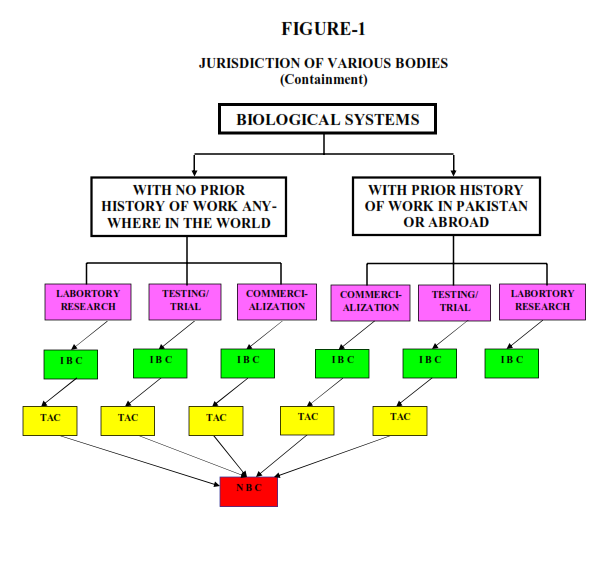
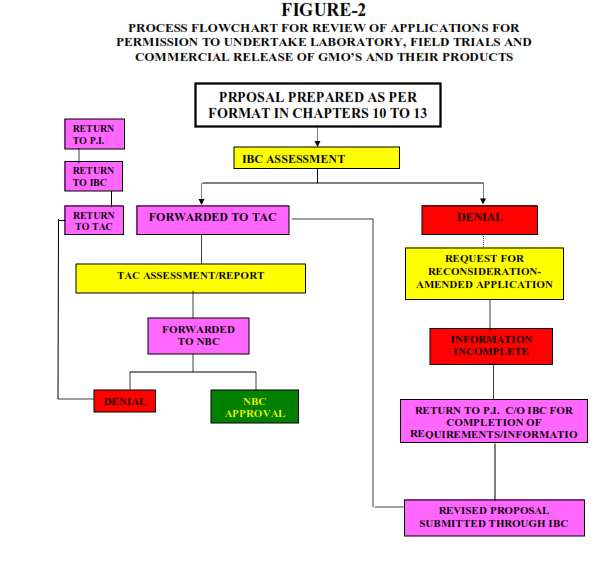
The guidelines propose that all "no risk" "minimal risk" and "low risk" works including laboratory work and field trials be assessed, evaluated and permission granted by IBC. All category 3 risk work (laboratory & field trials) be evaluated by and permission granted by the NBC. All works with no prior history of risk assessment and all requests for deregulation and commercial releases of Genetically Modified Organisms and products thereof, will be decided by NBC, on the evaluation/assessment report of TAC (Figure-1). All application, requests will be submitted to the relevant IBC which will transmit it to the TAC/NBC with its assessment/report for further necessary action. The communication channel will be IBC→TAC →NBC. Further, all clearances granted by IBC and TAC will be considered and decided by NBC. The secretariat of NBC will work as a national depository of all biotechnological projects. All applications and documents submitted to IBC for onward transmission to NBC will go through the relevant ministry to the TAC. The flow-chart is self-explanatory (Figure-2).
C H A P T E R 6
SPECIAL REQUIREMENTS FOR SOME LABORATORY GENETIC MANIPULATION WORK
6.1. WORK INVOLVING HAZARDOUS GENETIC FRAGMENTS
Isolating genetic material for laboratory use in host/vector systems may convey various risks and hazards depending, primarily, upon the nature of the genetic material involved. In particular, the following materials are recognized to bear substantial risks and hazards to laboratory personnel:
• DNA coding for various proteins, known or suspected to directly, or indirectly, regulate cellular metabolism, growth or division (e.g. growth factors/hormones and their receptors).
• Genes encoding lethal or virulent toxins.
• All oncogenes, especially those exhibiting high levels of gene expression or linked to gene promoters with high activity in human cells. For a particular DNA fragment, hazards are multiplied with the number of oncogenes encoded.
• Whole viral genomes.
• Fragments of viral genomes which retain the potential to regenerate live viruses.
The principal concern of work with hazardous genetic fragments is that the material involved may penetrate into the skin of personnel through cuts and surface wounds or contaminated needles, enter cells and get introduced into tissues. As such, gloves are required, at all times, to avoid skin contact and extreme care must be taken in handling sharp instruments, blades and edges e.g., needles and scalpels.
6.2. USE OF LIVE VIRAL VECTORS
Many vectors in common use are live viruses, developed to achieve unprecedented level of efficiency for the transfer of genetic material into cells. Live viral vectors, however, are often associated with a number of risks and hazards, most are not fully characterized but all are dependent upon the following criteria.
• Host range of the virus.
• Modes of transmission (e.g. air-borne, through body fluids).
• Infectivity and communicability (including epidemioloical considerations).
• Opportunities for repeated rounds of infection.
• Natural tendency of viral genetic material to become inserted into host cells and incorporated into host DNA.
• Nature of foreign genetic material inserted (including functions of target genes).
Nearly all proposals for use of live viruses as vectors fall into Risk Category 3, and accordingly, must be sanctioned by the NBC before work may begin.
Note: The following consideration and recommendations are meant to apply to the use of retroviral vectors but may be adapted for genetic manipulation work with other classes of live viral vectors as well).
6.2.1. Retroviral Vectors
The retroviruses developed thus far, have proven to be highly efficient for the transfer of genetic materials into a variety of cells. In principle, retroviral vectors are no different from conventional eukaryotic vectors in that all provide the fundamental regulatory sequences for the control of introduced gene expression.
The majority of retroviral vectors are replication-defective because the target gene(s) substitutes for or displaces a sequence of the genome regulating some important parameter of viral replication or of packaging of viral particles. However, this capability for viral propagation can be restored in cases where the missing genes are provided to the experimental system by the use of specific nondefective helper viruses. Alternatively, helper functions may be stable integrated into one of the chromosomes of a variety of packaging cell lines. Such lines will allow for the regeneration of fully infectious retroviruses but which cannot replicate and are not communicable/transmittable. Either way, the types of cells that may serve as hosts (i.e. that may be infected), depend on the particular helper virus adopted, or helper functions afforded by the packaging cell line chosen.
Retroviruses can be classified in a number of ways, but in the interests of these Guidelines, it is helpful to consider retroviruses on the basis of host range, as infectivity is a major concern of general biosafety considerations.
6.2.2. Classes of Retroviruses According to Host Range
Amphotropic retroviruses The Amphotropic viruses will grow in the cells of the species from which they were isolated and also in the cells from a wide range of other species.
Ecotropic retroviruses The ecotropic viruses will grow in the cells of the species from which they were isolated and to a limited or undetectable level, in the cells of other species.
Xenotropic retroviruses The xenotropic viruses are endogenous to a species but cannot replicate well in that species, generally because of a receptor block. They tend to have a wide range for replication in the cells of heterologous species.
As all the viruses described bear appreciable levels of risk and hazards (highly infectious), extreme caution is warranted regarding the nature of the target gene(s) when working with retroviral vectors. Where the introduced genetic material is itself hazardous, the risks involved are multiplied. In particular, extreme caution must be observed in handling retroviral vectors, capable of infecting and/or propagating themselves in human cells, which incorporate the following hazardous genetic material:
• known oncogenes of viral or cellular origin.
• genes coding for proteins which regulate, or may alter, the growth patterns of mammalian cells or forming the pattern of traits (e.g. growth factors/hormones and their receptors).
• genes encoding molecules whose activity/expression is modulated by the stimulation of growth factor receptors.
• genes coding for known or suspected toxins (e.g. cytotoxic proteins).
As with hazardous genetic material, the principal concern of work with retroviruses is the possibility of viruses entering cells and tissues through surface wounds and broken skin, or by accident. Most of these risks are directed towards those involved in the actual manipulations or working in the immediate vicinity, as retroviral particles are extremely labile and short-lived.
Construction of recombinant retroviruses must comply with basic National Biosafety Guidelines for laboratory genetic manipulation work. Once constructed though, the handling and application of these viruses must likewise proceed in accordance with the relevant supplementary procedures/practices detailed hereinafter (section 7.2.2. through 7.2.5.).
6.2.3. Approach to Non-Human Ecotropic Retroviruses
Non-human ecotropic retroviruses, because of perfectly limited host range, will not grow to any significant level in human cells and are not regarded as dangerous to laboratory personnel. Simply the adoption of good tissue culture practices is enough to ensure a satisfactory laboratory biosafety environment. Nevertheless, it is strongly recommended that various fluids, wastes and by-products from experimental cell cultures and organisms be thoroughly decontaminated/inactivated before disposal, to prevent such ecotropic viruses from fortuitously infecting natural cell lines.
6.2.4. Approach to Defective Retroviruses with Human Cell Host Range
Inherently, retroviruses with human cell host range are amphotrophic, xenotropic or human ecotropic viruses. All may bear substantial risks to laboratory personnel if associated with hazardous gene sequences. Even where the risks are reduced by the use of defective retroviruses, investigators must strictly abide by good virological and tissue culture practices, with special emphasis on the following precautions:
A. Perform all manipulations and handle all cultures of viable retroviruses in Class II biological safety cabinets or equivalent primary containment units. Only one individual may use a biological safety cabinet at any one time.
B. Handle cultures of amphotropic retroviruses or of cells, infected with amphotropic retroviruses in 'double-hulled' units (e.g. plates with inverted lids) to trap accidental spills,.
C. Store amphotropic viral stock in an appropriately designed and isolated section of the freezer and store ampoules of frozen amphotropic cell lines in a separate section of the liquid nitrogen tank. All such divisions need to be properly labeled/tagged. Laboratory personnel are responsible for the care of amphotropic viral stock and cell lines.
fore use with other non-amphotropic retroviral stains. Where recombinant amphotropic retroviruses are to be propagated in human cells, there is a need to show that cultures are free of human retroviruses. Nonetheless, cell cultures from laboratory personnel and their immediate relatives must never be infected under any circumstances, with any class of retrovirus.
6.2.5. Handling of Animals Infected with Non-Human Ecotropic Retroviruses
As non-human ecotropic retroviruses bear negligible hazards towards laboratory personnel, the adoption of good animal handling practices is considered adequate for work with infected animals. As a standard procedure, wastes, secretions and by-products from experimental animals must be thoroughly decontaminated before disposal, to avoid inadvertent infection of wild relatives and natural variants.
Infected and uninfected animals must be kept in separate cages (but may be held in the same room) to minimize the opportunity for repeated rounds of infection.
6.2.6. Handling of Animals Infected with Retroviruses with Human Cell Host Range
The infectious retroviruses, with human cell host range, need stricter precautions to those precedent. As basic requirements, infected species must be kept in separate, appropriately labeled cages (and apart from uninfected animals) and all wastes, secretions and by-products from experimental animals must be thoroughly decontaminated/inactivated before disposal. In the laboratory, work benches should be layered with protective paper, which needs to be replaced regularly.
On top of good animal handling practices, stringent arrangements must be made to enhance physical containment, preventing escape and spread of infection. Extreme caution must be observed when dealing directly with infected animals to avoid being bitten, clawed or scratched--in performing operations, gloves and cover-all must be worn to avoid skin contact with animal tissues and body fluids.
In spite of all safeguards, handling animals, infected with retroviruses with human cell host range, guarantees much risk. Only highly trained and proficient personnel, under supervision of the project supervisor, should be allowed to operate on infected animals.
6.3. WORK WITH WHOLE PLANTS
Recognizing the relative facility with which many plants propagate, disperse and outcross, field testing work on plants requires for submission "Supplementary Information" in addition to the standard project proposal. The supplementary information will include details of the auto-ecology of relevant noxious weeds and plans for cultivation of transgenic species. The additional details provided in supplementary information will be reviewed by the IBC and shall constitute the framework for committee recommendations regarding containment, disposal and safeguards.
Criteria to be followed for field testing of the transgenic plants that do not meet the criteria in Section 3.2.1.
A. Maintain at least the minimum isolation distance recommended for raising "Foundation Seed" all around the transgenic plants. The distance will vary from crop to crop. In the isolation distance a non-compatible crop can be grown. Alternatively, the researcher could bag flowers to prevent pollen flows. In the case where seeds are not needed, remove flowers or destroy plants before flowering.
B. Beyond the isolation distance, grow a few rows of nontrangenic plants of the same crop to serve as a pollen trap for insect pollinated crops such as cotton.
C. Analyze the seed progeny from the plants used as pollen trap for accessing pollen escapes and verifying the effectiveness of the isolation distance. The experiments conducted to monitor pollen escape into compatible border row plants should be maintained that will be useful for risk assessment.
D. Pre-release tests of genetically engineered organisms in agricultural applications should include elucidation of genetic markers, host range, requirements for vegetative growth, persistence and stability in small plots and experimental field trail.
6.3.1. Post Harvest Handling of the Transgenic Plants
A. Destroy by burning all the left over vegetative parts and left over seeds, if not needed for future experiments.
B. Leave the land fallow next year and destroy the plants, if any emerging from the seeds of last year in the soil.
C. Soil samples in experiments under controlled containment conditions should be tested for the absence of viable cells before disposal into the environment.
The relevant biosafety committee initially may clear a project for limited field trials which may be enough to have data for assessing the environmental impact in case it is necessary. Where such environmental impact studies are not warranted, the committee may give permission for large scale trials.
6.4. ENGINEERING OF TRANSGENIC ANIMALS
All genetic manipulation work on live animals, fertilized oocytes or early embryos, to the extent that a novel organism results, falls into Risk Category 2. Nevertheless, proposals for such work that entails the introduction of viral genetic material or whole viral genomes into zygotes and embryos official IBC authorization must be reviewed by the NBC.
6.4.1. References
The following references are essential to all investigators and IBCs involved in genetic manipulation work with transgenic animals:
• USDA/APHIS 1999, http://www.aphis.usda.gov
• OECD, 1999. http://www.oecd.org/biobin
• ISAAA, 1995. Food safety evaluation for the products of biotechnology. The ISAAA food safety initiative, ISAAA, Ithacca, N.Y.
• Australian Code of Practice for the Care and Use of Animals for Scientific Purposes, 1990 (prepared by the NH&MRC, the Common wealth Scientific and Industrial Research Organization, and the Australian Agricultural Council).
• Australian Standards 2243-1991 Safety in Laboratories: Part 3-Microbiology (basic standards for animal houses).
• Procedures for Assessment of the Planned Release of Recombinant DNA Organisms, 1987 (available from the GMAC Secretariat, GPO BOX 2183 Canberra ACT 2601, Australia).
Other key references and recommended reading are listed under Appendix-1.
6.4.2. Supplementary Information
If the proposed work involves genetic modification of animals, the project supervisor must prepare a "Supplementary Information" for the Engineering of Transgenic Animals, addressing the various concerns in the design of animal containment facilities as are outlined in Appendices 10 and 11. Append all supplementary information to the Project Proposal Form for Assessment by the supervising IBC. The supplementary information will guide the IBC in reviewing the design of animal housing facilities, as appropriate containment measures will vary with different experimental and biological systems. Further, the project supervisor must ensure that no work shall start prior to receiving IBC endorsement.
6.4.3. IBC Assessment for Proposals for Engineering Animals
While considering a proposal for the genetic modification of animals, the IBC must inspect all animal containment facilities to be used, in addition to reviewing the various written forms submitted. Where work raises moral questions and concerns, the IBC should consult religious scholars and other personnel well-versed with bioethics.
If the IBC endorses the proposal, it must immediately forward with copies of relevant assessments and the original submissions to the NBC. Only after receipt of NBC approval and complete reassessment of proposals, may the IBC give authorization for research work to begin. If final endorsement is conditional upon the adoption of additional provisions, send a copy of the terms of approval--under heading of the IBC Form for Assessment of a Proposal to carry out Laboratory Genetic Manipulation Work--to the project supervisor.
6.4.4. Important Points:
Experimental animals may range from small, laboratory species (e.g. fruit flies, mice, rabbits) to large, domesticated species or livestock (e.g. sheep and cattle). As such, the scale of housing requirements may vary considerably from one proposal to another, although in principle, microbiological safety considerations would remain similar. On a related note, in case of the considerable scale involved NBC guidance may be required of work where large numbers of transgenic animals are to be handled together.
The outcome of any introduction of novel genetic materials into the genome of animals is never entirely predictable. No matter how precise the method of introduction, the desired gene expression cannot be guaranteed, and transgenic animals may instead exhibit incidental genetic and phenotypic variability (depending on a number of factors, particularly the stability of incorporated transgenes, their effects on neighboring operons and related changes in biosynthetic and energy demands). The method for introduction of donor DNA can likewise bear undesirable side-effects. Researchers must refer to the IBC, those cases where trasnsgenic animals harbor infectious agents that are transmissible to other animals or humans within the same holding facility. Concerns regarding possible/likely routes of transmission must be removed. Ideally, accommodations for experimental animals in laboratory genetic manipulation work, need to be physically separated from facilities supporting other activities, such as animal nurseries and animal quarantine areas. Where there is to be concurrent use of a transgenic animal house, researchers must adopt suitable precautions to avoid interference with the proposed work.
6.5. GENETIC ENGINEERING OF INFECTIOUS ANIMALS
Genetic engineering of infectious animals -- including transgenic animals produced by the introduction of genes from infectious agents, and animals which incorporate genes encoding infectious particles--need special housing considerations addressing the particular risks conveyed. For the most part, physical containment precautions for laboratory work with these animals would follow the general requirements of C1A or C2A animal houses (Appendices 10 and 11 respectively), as appropriate to the level of concern. However, higher levels of animal containment will be warranted and investigators must refer such instances to the NBC for consultation with the committee regarding special conditions to be adopted. Ideally, animal houses must be integrated with the main laboratory to facilitate transport, observation and experimentation.
As a general principle, the biological and physical containment consideration, for such in vivo work are comparable to those for work with infectious agents in vitro.
Note: As a reference, the housing of infectious animals must observe the Australian Code of Practice for the Care and Use of Animals for Scientific Purposes, NH&MRC/CSIRO/AAC,1990.
 PDF